

Ají Press: Collaborative Publishing as a Line of Flight
Interview by Audrey Markel
Editing by Gabriela Román González
All images courtesy of the interviewees
Conversation with Juliana Monsalve Carrillo and Santiago Valencia Parra, founders of Ají Press.

'Mapping Carrier Artefacts' workshop with Rebeca Romero at Copperfield Gallery. Photo Ají Press
Ají Press is a collaborative publishing platform working across design, curation and research. Rooted in Juliana Monsalve Carrillo and Santiago Valencia Parra’s shared experience of moving from Bogotá to London, the project explores materiality, language, and collaboration as ways of thinking through the Global South.
In this conversation, we reflect on publishing as a space for experimentation and positioning, from print and materiality to language, translation, and circulation.
On materiality and the printed object
It’s particularly compelling to see your commitment to a physical publication. In a moment where digital content dominates, what is the significance of a physical and limited-edition magazine?
Juliana: One of the reasons why we chose to make Ají a physical project is because at the time when we started, I was working with publications and printing as a designer. I found there's great value in how we interact with objects.
Within digital platforms, our interactions with content are highly structured. We scroll up and down or sideways. But with publications, there's so much more that can be done. We could also communicate through the format, the way the pages move, and how readers touch the paper.
In the first issue, text appears in different directions, it spirals, and there are small inserts within it, leading the reader to grab the magazine in a different way. We found that within print, we could explore communicating and learning, not only through the content itself, but also the way the content is displayed. We also decided that every issue was going to be different. We are working on the second issue now, which is going to have a different format and layout, because we want to keep ourselves creative, but also in a way, surprise the reader.
Santiago: For us, materiality and the way of thinking about publishing goes beyond the idea of a bounded book, but thinking about publications via workshops, through collective making, graphic exercises that emerge from a certain context. The way we have worked around materiality in the whole project, is also our way of developing our own language to respond and dialogue within different situations. At the same time, the digital remains important, because part of our network and our community is built through digital platforms. You have to make social media work for you, and not work for social media.
We share on our platforms exhibitions that we think are relevant and that bring important themes into the contemporary art and design circuit, what is happening at art fairs, what is happening around Indigenous artists, what is happening around Latin American artists that are having exhibitions in London, or spaces that we have had the privilege to visit. For us, digital mediums are an important platform, as long as we use it in an ethical and a way that responds to what we're trying to build as a project and a community.
Publishing as a political space
Do you see the materiality and print of the publication as political or decolonial gestures — perhaps in the way they offer slowness and reflection?
Juliana: There are at least two ways in which we approach the project as decolonial. One of them is that in publishing, I feel the audience is very used to expecting temporality - publications that come out four times a year, or biannually a year, or in a specific month, but we don't follow those timelines for various reasons. Ají is a project that moves along multiple people and multiple lives, not only ours, but our contributors. So how can the project also respond to an organic way of making that doesn't push the content out just for the sake of producing?
Publishing also tends to be highly influenced by Anglo-speaking interests, whether it be through the content, authors, or the references. This is one of the reasons we started Ají. We realized there were so many things happening around us in London. We were meeting many people and their practices were so interesting that we wanted to put them together, and explore how that would look, and how we could share our collaboration with them.
When we moved here, we encountered a number of things that eventually led us to Ají. We named the magazine Ají because Santiago had been researching the chilli pepper, which we call ají back home. He came across a story from the colonial period, when the Spanish tried to use it as a substitute for black pepper. They brought it to Europe, where it began to spread, but when people ate it, it burned their throats and made their bodies react. We really liked that as an analogy of people questioning, what am I reading? What does this mean? Global South? Why are they defining the Global South? What are they attempting? That's one of our objectives with Ají, to unsettle people’s thought processes.

'Bogar, bogar, bogar' by Angélica Rojas in Ají Vol. I. © Ají Press
Santiago: Publishing in the project is political also in the sense that we start from the idea of what is the Global South. We have conversations around this concept, its limits, its possibilities. Starting from that stance, we think about what it means to have a creative, architectural, and curatorial practice that comes from the Global South, that dialogues with the Global South, and that may or may not identify with the Global South. From that point on, the content we share, and the content that we work with, is political.
For example, in the first issue, we had contributions from Argentina, another work from Nigeria, and from different parts of the Global South. When they were brought together, they created really interesting discussions. That type of connectivity in itself is political, and reflects the power of thinking under the umbrella of the Global South. How can you create connections that are not necessarily identity connections? We don't want to build an identity of what is the Global South, we reflect on it, and create connections between its possibilities.
Juliana: We're not looking to define what the Global South is, but finding connections and dialogue between different communities and territories. We have found within those dialogues things in common come up. In the first issue, unexpected topics we didn't plan came out, for instance, censorship, different representations of the body, or addressing sexuality. All of these themes started to appear without us specifically targeting one of them.
Santiago: Because of the nature of the project we made a decision to include both Spanish and English in the first issue. I'm not talking about translations that you find between Spanish and English. For the first publication, we meant to have contributions that were just in Spanish and just in English. Because for us, language is a special place for each one of these projects to develop and have a meaning based on the territory, the history of the project, and of the person behind it. Language is another example of how the projects we work with revolve around political thinking. It's a choice you don't normally see reflected in mainstream publications.
We published in English because we're based at the moment in London, and our main audience is here. But again, we want to challenge the idea that English is a universal language that everyone communicates through. So what happens when you are faced with reading a text you don't understand? This is the case of many people that live in Latin America that don’t read or speak English. They're constantly pushed to learn, speak, and seek opportunities in English speaking countries. For us, the use of language is quite political and deliberate.
Juliana: When we were looking at the content, there were texts in Spanish that we knew we could translate, but it wasn't right. There's things in Spanish that only exist in Spanish, and moving into another territory will change their meaning completely. We felt that wouldn't be fair with the piece, so we kept them in their original language.
In some conversations, it came out that it might be offputting for the audience if it was in other languages they couldn't read. But we didn't have that response once it was out there. People became curious, even though they couldn't fully understand it. That's part of challenging the readers.
Design as unlearning
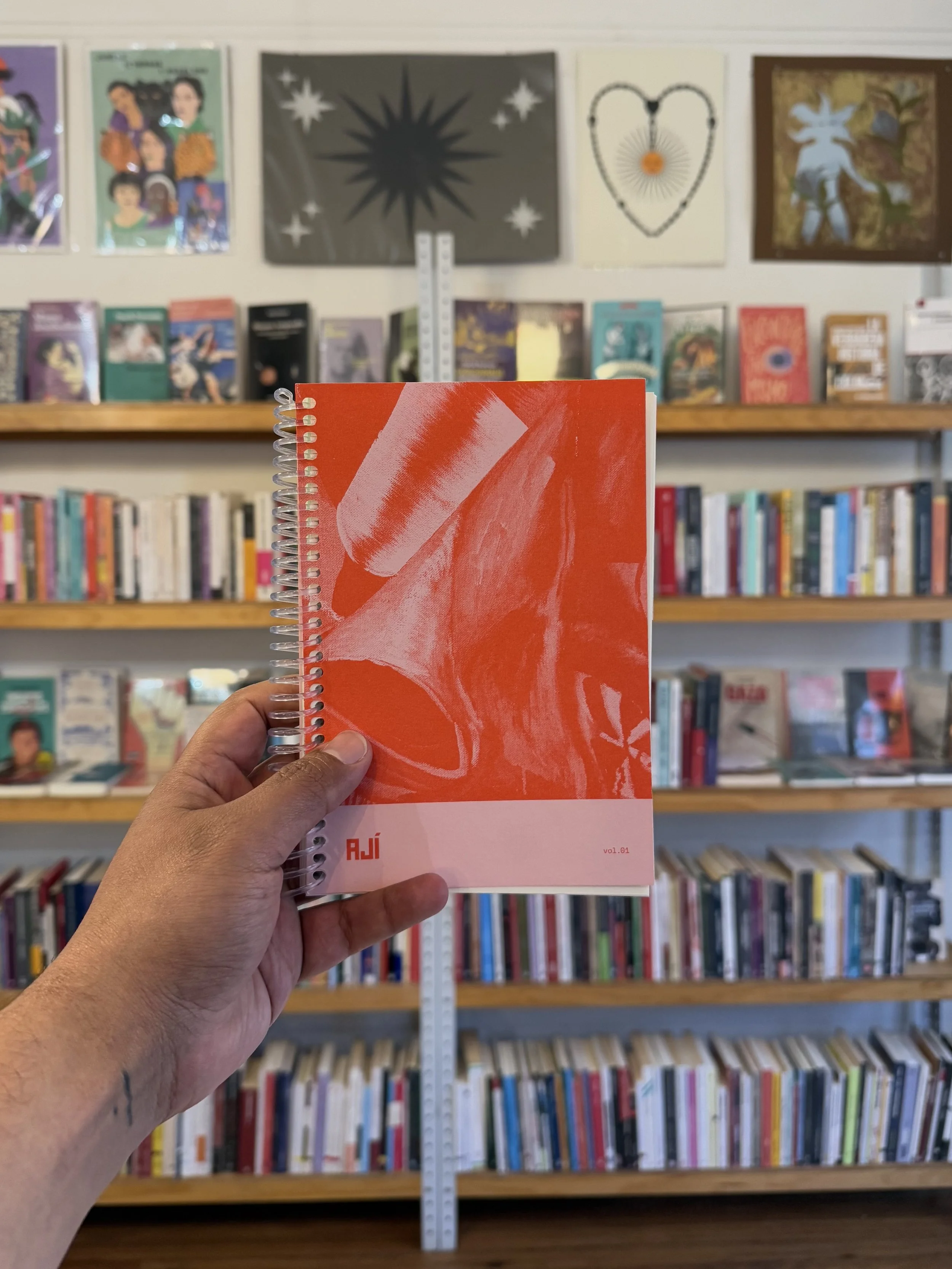
Ají Vol.I at NADA Bookshop, Bogotá. Photo Ají Press
Juliana, how do you approach design not just as an aesthetic decision, but as a conceptual practice?
Juliana: When I was doing my master's, I focused on editorial design, and that's when I reflected on the standardisation that exists within publishing. There's so many rules around what's right and what's wrong, and that leads to a lot of books having the same structure and format. A lot of those principles go back to big influences such as Swiss design and distribution demands. When I was doing Ají, I started to and still feel I’m constantly trying to unlearn. My design background is heavily influenced by European design decisions, but I'm not geographically close to these spaces. I was trying to challenge myself with the first issue, how can I do this differently?
One of the decisions was to use a font designed by Tangrama, inspired by Colombian artist Antonio Caro. Every time I'm faced with designing, I try to think, how can I unlearn a bit of the rules that I've learned, that are very structured and European centered, and how can I bring forward references from our background that can also inspire the magazine’s graphic langauge?
We also made the decision to print in risograph, which meant the process would be slower for us. Printing with a risograph means you have layers and it takes more time, and you're never going to actually know what the result is going to look like. You can try to mimic how the images are going to look on your computer, but it's like putting your hands on the fire. It also means that the reader sometimes has to look a bit closer because a lot of the pictures are in two or three colors. For instance, the image we chose for the cover by Lucia Vera, is a zoom on another image. It's a non-figurative painting with a filter.
Santiago: The publication itself makes you slow down if you want to see everything.
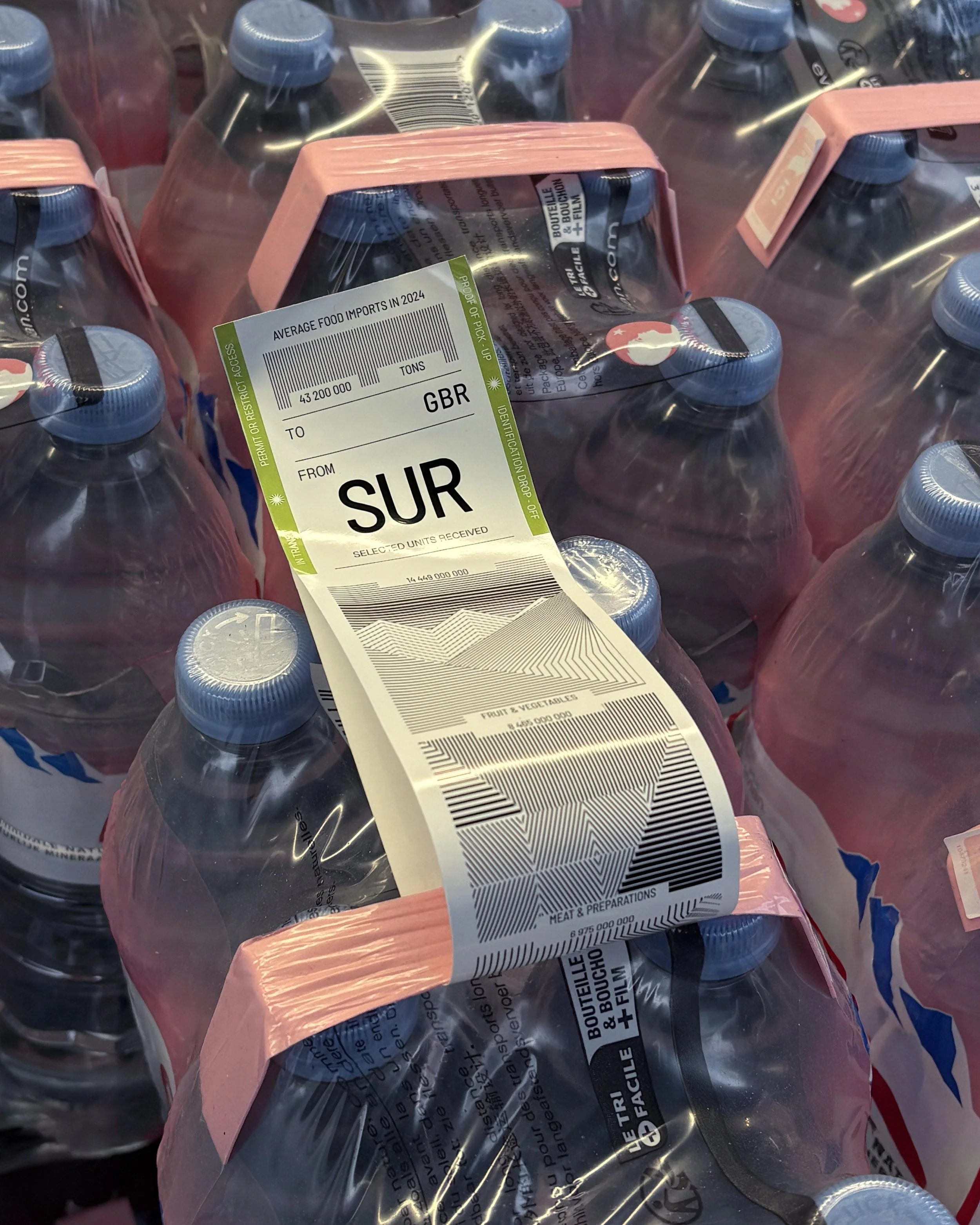
SUR. Airport bag label, © Ají Press & Felipe Pineda
Publishing as archive and platform
How do you see the future of publishing and of physical publications?
Santiago: I think all of them at the same time. We're both a bit obsessed with the idea of archives. We're big collectors of papers, postcards, books, zines, magazines, etc. Ají is us trying to build our own archive, our own practice, but also doing that with others. It’s not about us, we're just the face of the project. But in reality, this project and this archive is going to contain many voices of all the people we have worked with. Building the future of the project and the future of the publications that we have envisioned by continuing to create volumes, allowing us to curate different types of publications that from now on will be theme oriented. That allows us to have even deeper conversations with the projects and the people that we work with, and think of these publications also as exhibition spaces in some way. We can build these exhibition projects from another perspective, not only thinking about art, but also about design, writing, poetry, and architecture. We think of publishing in the workshops we do, the events we host, while being invited to activate exhibitions and conversations, as well.
Juliana: We embrace the idea that publications are not just a bounded book, but the act of publishing is to circulate information, and circulating information can look in a lot of different ways.
Santiago: We envision, and hope, for the project to become a community, an opportunity for having these conversations around what it means to have creative practice in the Global South. You can find tension in these conversations and you can find people that are not on the same page, but confronting all those points of view will create a richer future.
Locating a line of flight
The theme of this series, and of Lines of Flight at CASA, explores how we move beyond fixed ways of knowing and making, and what new possibilities can emerge in the process. Where do you each locate a line of flight within your own work in publishing, design, curating, or cultural production?
Juliana: My own line of flight is within publishing and how to push the boundaries. I feel that publishing is standardized, which is a good thing because of legibility and it's easy to distribute, but at the same time it's a bad thing to think that we all access content the same way, whether it be through language or materiality. I really want to question what a printed publication is, and we started to do that through formats, but I couldn't do this without working with Santiago. He pushes care through the content and the words, and where we should focus our gaze.
Santiago: What is interesting about the project, and what resonated for me as I’m a professional that works in the arts, is that the line of flight of Ají is not entirely a publication or a design project. When we look back at the collaborations, the texts we have published, we moved into this gray zone that I think is really productive. We’re not chained to being a design project that needs to become relevant in a specific field. Pushing those boundaries, like what does it mean to have a designer and a curator working alongside each other? What conversations can happen? How should it look? What is the purpose of the project? Raising those questions becomes productive and makes people ask, what is Ají?
Juliana: We get that question a lot, but we constantly have conversations of how it expands and moves in different directions. Sometimes we back away from giving Ají a specific definition. Now, we feel comfortable saying that it's a collaborative platform. That's the direction in which it is currently going, and I think that's the project in itself.