

Mara Polgovsky Ezcurra: Embodied Lines of Flight in Performance and Politics
Part of “On Record: Where We Move Sideways,” a Not The Owners editorial series for “Lines of Flight,” CASA multi-arts programme at Brixton House
Interview and editing by Audrey Markel
Conversation with Mara Polgovsky Ezcurra, Senior Lecturer in Contemporary Art at Birkbeck, University of London, and Director of Peltz Gallery.
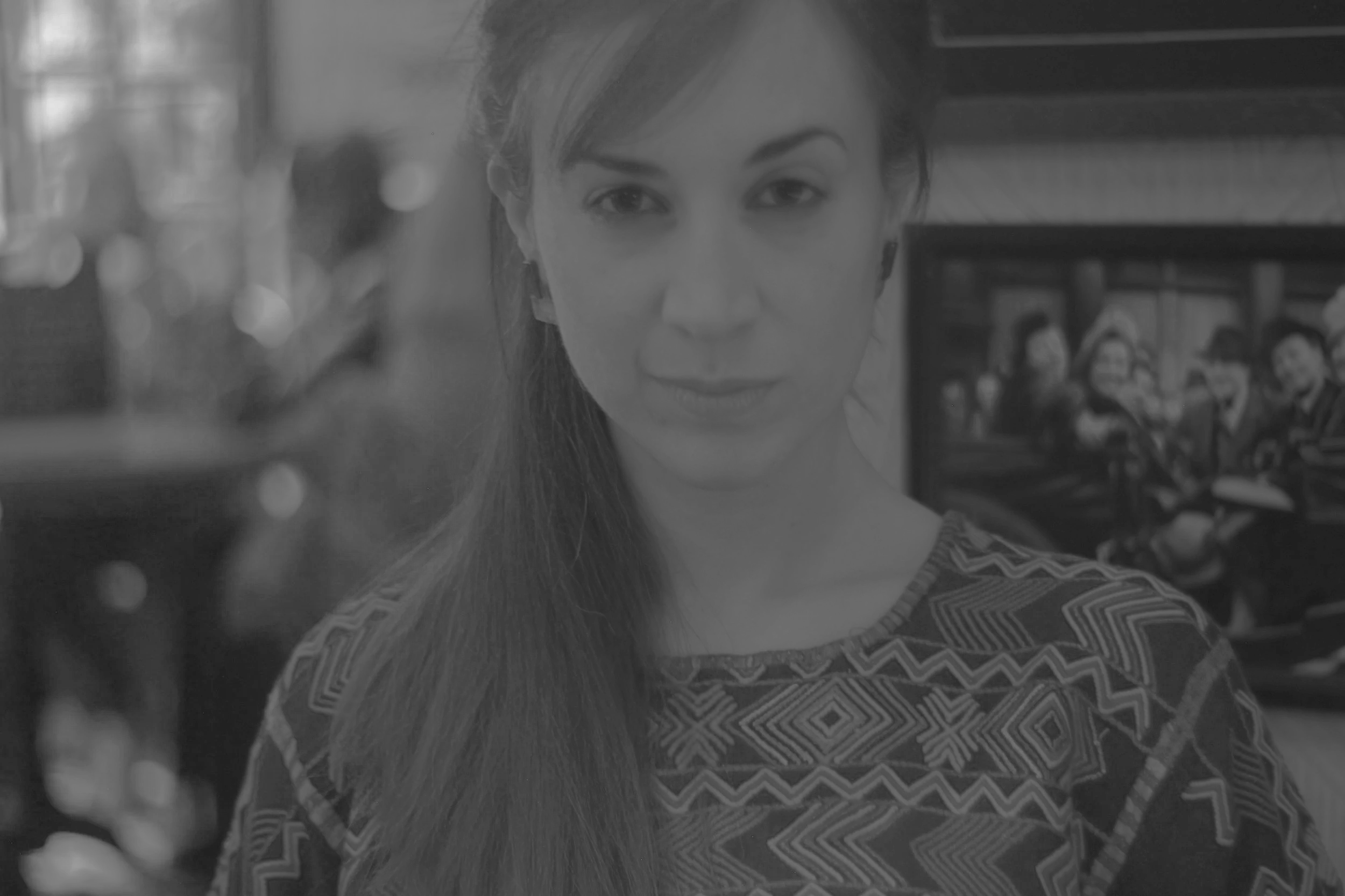
She is the author of Touched Bodies: The Performative Turn in Latin American Art (2019) and Marcos Kurtycz: Corporeality Unbound (2024), among other publications. Her edited books include The New Public Art: Collectivity and Activism in Mexico Since the 1980s and Sabotage Art: Politics and Iconoclasm in Contemporary Latin America. Her art criticism has appeared in Afterall, Tate Etc., and Post: Notes on Art in a Global Context.
In this conversation, we discuss performance, corporeality, and the political stakes of embodied practice in Latin American art. Rather than treating performance as a discrete medium, Polgovsky understands it as a broader performative turn that reshaped how art acts in the world, across writing, image-making, and objecthood. At the heart of her thinking is the body, not as a fixed site of identity, but as a vulnerable, relational, and constantly changing point of encounter.
-
In your PhD thesis, “Touched Bodies: Corporeal Ethics in Latin American Art at the Onset of the Media Age,” you describe how Latin American performance artists use corporeality to negotiate intimacy and power at times of intense political hardship. How might these embodied actions function as lines of flight? Movements that rupture dominant narratives about Latin American bodies, femininity, and political identity?
Mara: I've always been interested in performance, partly because I used to be a dancer. I was fascinated by the way in which the body somehow resists discourse. That was my initial point of understanding what corporality was, with flesh as this kind of excess with regard to narratives or ideologies.
However, in my theorisation of performance I was more inclined to think about the body with Jean-Luc Nancy’s work; not as the opposite of discourse, but more the body as a point of encounter between flesh and discourse. We are the body, and we negotiate our corporeal subjectivity through language. I also felt that talking about performance as a medium was limited, because a lot of corporeal practices are intertwined with linguistics practices. For instance, in Chile, as we can see in the work of Raul Zurita and the Colectivo de Acciones de Arte (CADA), the emergence of performance art happened during poetry readings. The experimentation with the body as a time-based medium unfolded from these spaces characterised by limited (discursive) freedom, and where poets, artists, writers, and social scientists got together nonetheless.
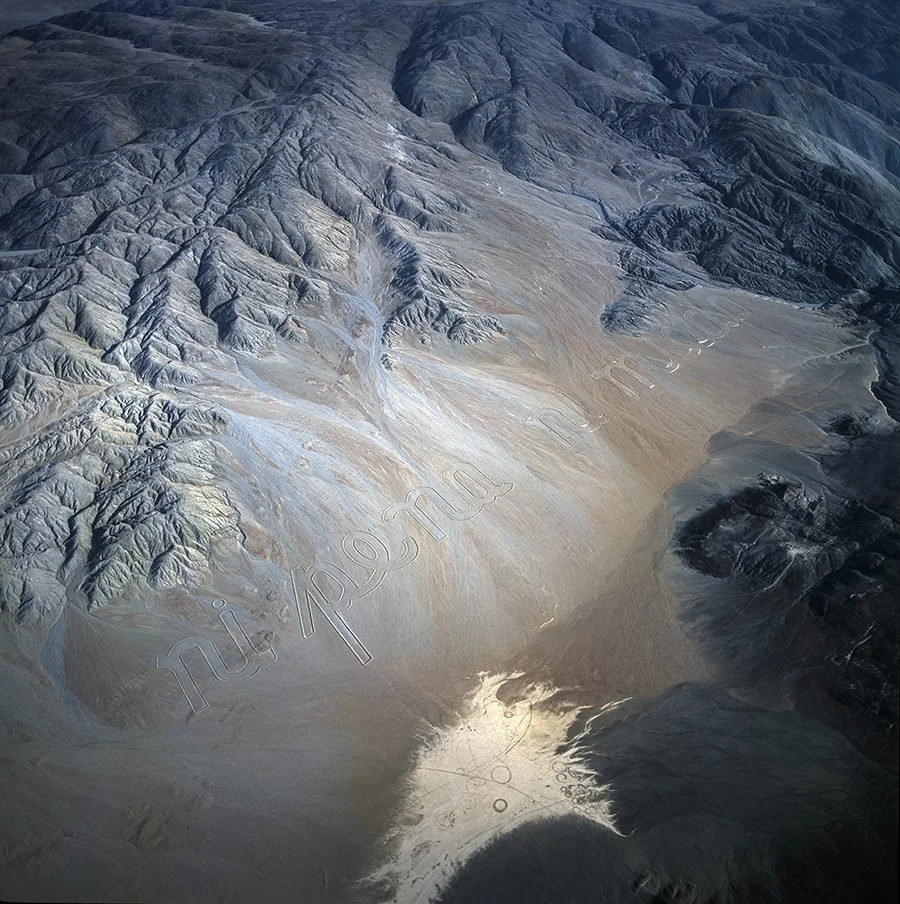
“Ni Pena Ni Miedo” (No Pain Nor Fear), Raúl Zurita poem inscribed in the Atacama Desert. Photo by Guy Wenborn (1998)
Yet, I approached performance not as a discrete medium, but as an intermedial practice engaging time and the body in conjunction with writing, drawing, and sculpture. I wrote about a performative turn that affects all media; i.e., suggesting not that performance emerged and became a new possibility for art, but that performativity affected all art forms. We began looking at painting differently; paintings doing something to us and evolving over time, as W.J.T. Mitchell and T.J. Clark would say it. What does the painting want? Does the painting have agency? Performance opened a horizon of interpretation that wasn't so readily available before live art became a recognized artistic medium.
I was also responding to an important tradition of performance theory - one of the better-known voices being Amelia Jones - that understood performance primarily through the lens of identity and subjectivity. I was more interested in the sense of touch, associating, by contrast, identity with vision, and the representation of something that tends to be fixed: female identity and/or male identity, Latin American identity and/or European identity, for example. I understand the sense of touch through the work of Emmanuel Levinas and a number of avant-garde artists that reject a gaze that classifies and reifies things. Touch more in the sense of exposure; what we want, what we desire, what we want to be is unknown.
I looked at a very important moment of political transition in the 1980s, when there was what I consider to be a crisis of ideology. Prior to this, in the 60s, we could say that Latin America was fighting for revolution and decolonization. That came to a crisis in the 1970s, when the military coups and subsequent dictatorships in Argentina, Chile, Uruguay, Brazil, etc., led to a crisis of political projects. Once the idea of revolution starts to die, it becomes unclear what the political means anymore, and what a leftist political project would mean. That’s when the body gained unparallel relevance in defining the realm of the political, involving the limits of the body, the meaning of desire, the forms through which one can feel pleasure and pain. It is a different form of politics than the big idea of a revolution; it's much more intimate and subjective. To me, that political project is negotiated in part through the exposure of corporeal vulnerability, intimacy, and finitude. Therefore, the performances I've studied do not involve embodying certain forms of identity, which is an important and valuable tradition of performance art, but involve a different discussion around corporeality. When Diamela Eltit cuts her arms as a form of writing, for example, she’s far from performing her femininity through nudity, along the lines of a certain kind of 1970s feminist subversion that we see in Carolee Schneemann, among others. The fact that she is a woman is important, but it's not defined through her breasts or her vagina. Through this both exposure and appropriation of her vulnerability, she defines the form and meaning of her idea of pleasure and pain, not letting the dictatorship appropriate the whole realm of morality, and not letting anyone else define what her pleasure or her pain are like. Looking at this and other case studies, I moved away from older discussions around the performance of identity, instead focusing on liveness and vulnerability as well as the ethical complexities they entail.
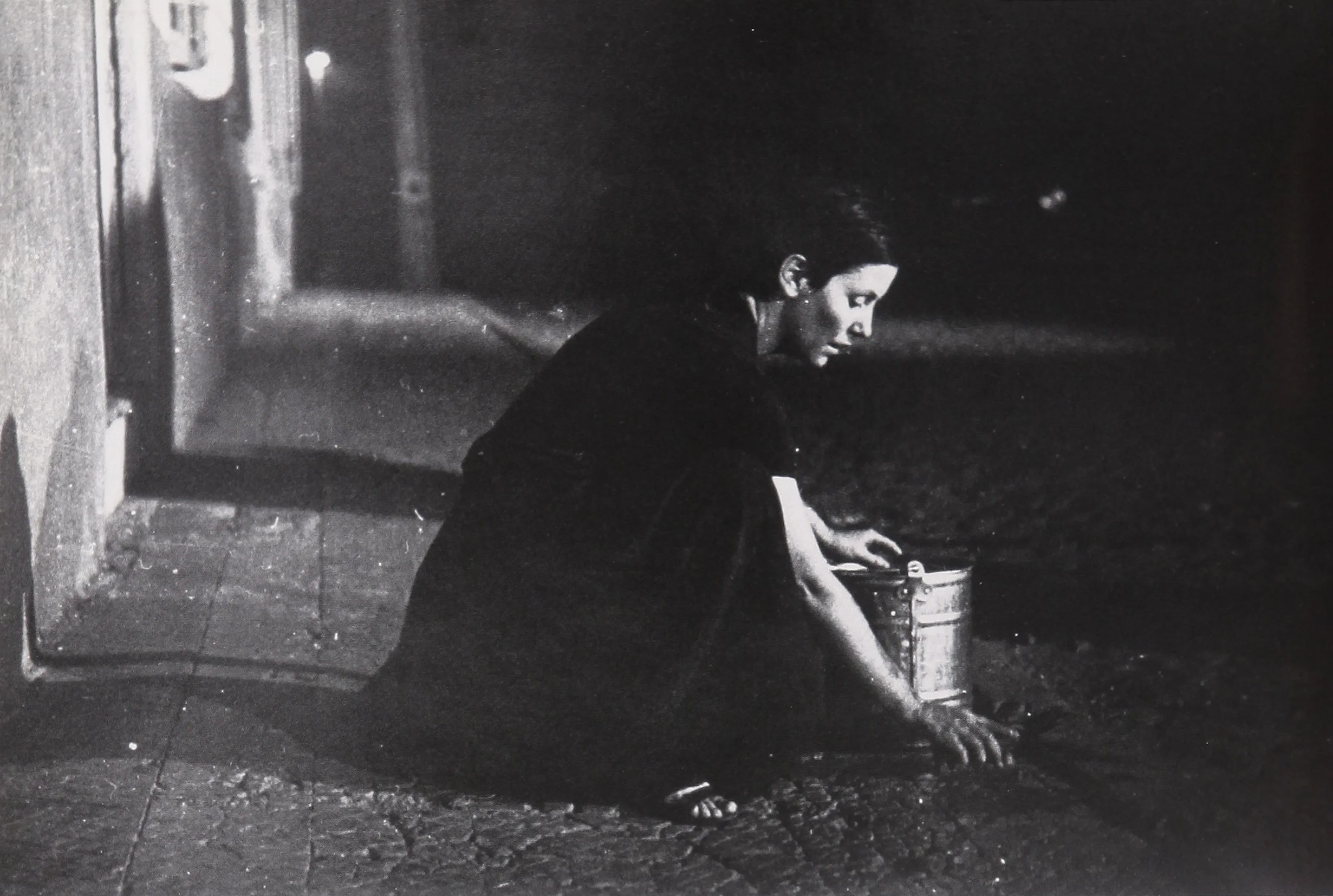
Zona de dolor II (Zone of pain II), 1981, Diamela Eltit
In thinking about participatory aesthetics, specifically Lygia Clark, and how it relates to performance, how do you feel it changes from individual to collective experience?
Mara: I really enjoyed the Lygia Clark show at the Whitechapel Gallery recently. What Claire Bishop called ‘delegated performance’ can go in various directions. I believe that Bishop has a point in terms of how delegated performance can become exploitation or can put the spectator in a situation that’s extremely uncomfortable. Think of Tania Bruguera’s Tatlin's Whisper #5, which involved police horses charging the public in the Turbine Hall.
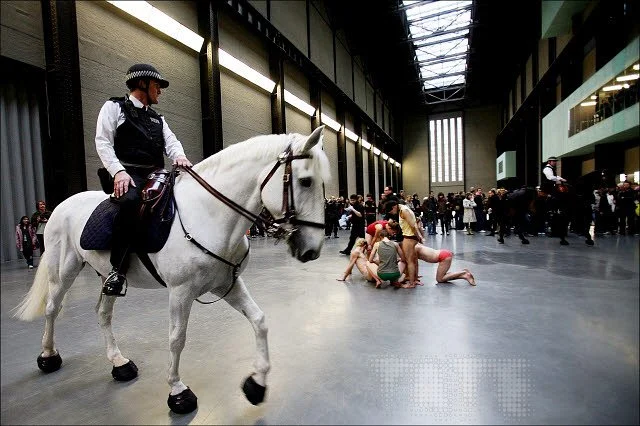
Tatlin’s Whisper #5, 2008, Tania Bruguera
But the work of, for example, Lygia Clark and Hélio Oiticica is so open that it allows for the spectator to have agency, and to pour their imagination into how they deal with performative rituals. At the Whitechapel, there was this piece which involved elastic bands called Rede de elásticos (Elastic Net). I saw it, or rather experienced it, with my three-year old daughter and it just felt natural to be playing. The piece incites play and turns the museum into a site for collective experience.
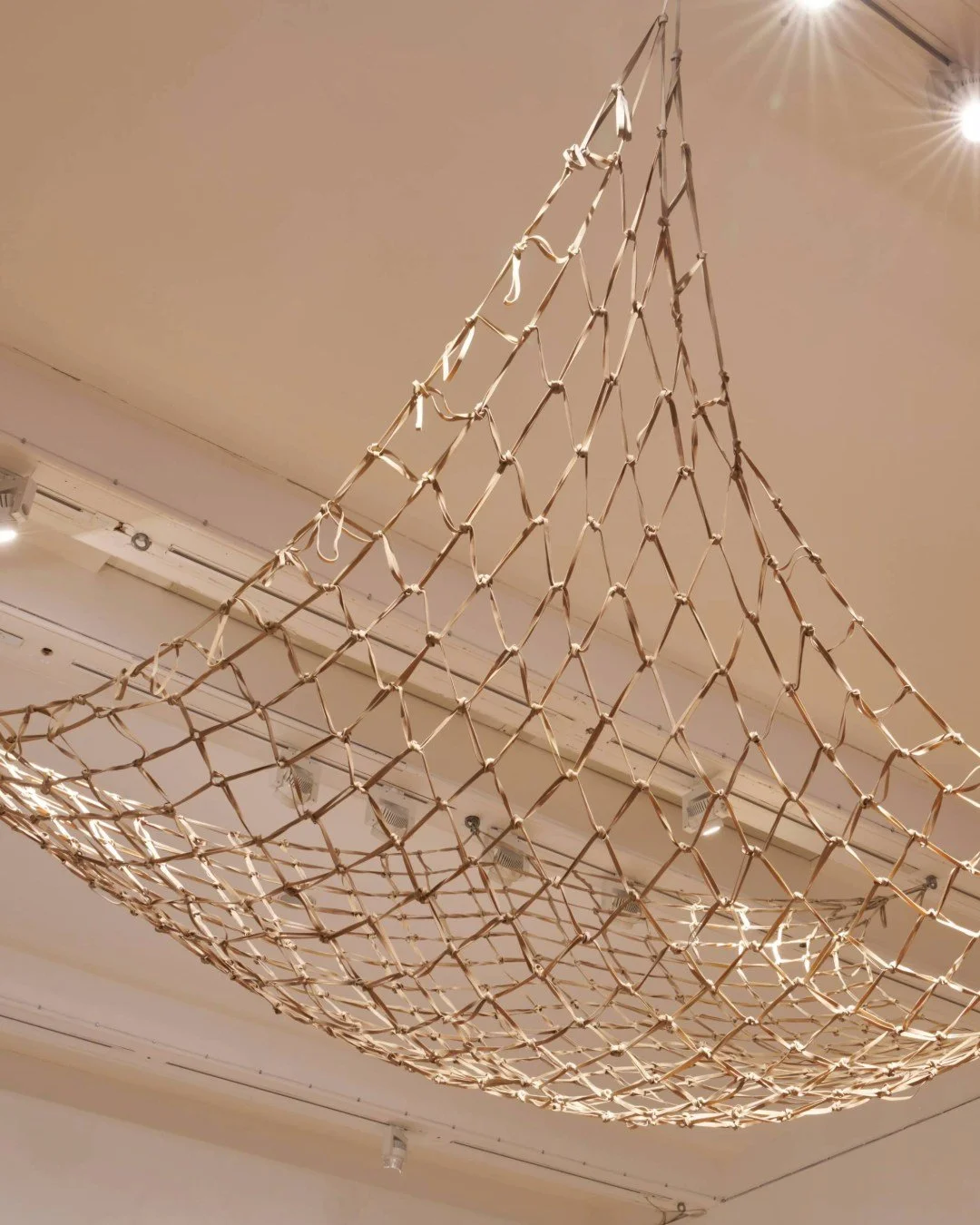
Lygia Clark, Rede de elásticos (Elastic Net), 1974, Whitechapel Gallery
As spectators, whether you have studied art history or have been a dancer, we go to the museum and become almost bidimensional, we negate our own bodies. In participatory exhibitions that ask you to throw yourself into the possibility of reinventing yourself or seeing differently, the invitation in not just to look, but to sense ourselves and experience the work through all of our senses, interactivity as a form of awakening the totality of our sensorium, often not as an individual but as a collective.
I've been looking at that history in my research, partly through the ways the avant garde was influenced by science and technology, for instance, by cybernetics, and viceversa. In exhibitions like Cybernetic Serendipity at the ICA, there is a clear shift in the division of power between artist and spectator. Rather than fully endorsing Bishop’s view, I like to think of this participatory possibility for the spectator as an open microphone, in the sense that it can go in any direction: the spectators are given the chance to talk back, which can feel very intimidating, but this gives them an agency that wasn't available before.
The way in which different senses can be prioritized by artists, and how the work can control the senses that are being used is fascinating. I think ritual is crucial to the understanding of not only performance, but within the context of Latin American history, gestures, and somatic practices that carry histories of resistance. How do you see contemporary performance artists drawing on or transforming these traditions? And how might diaspora change the meaning of those same gestures when they're performed outside of their original cultural spaces?
Mara: I don't look at diasporic artists too much, to be honest. I tend to focus more on Latin American artists working in Latin America. The artistic diaspora is often associated with a sense of precarity, dispossession, and being uprooted from their cultural origins. In reality, artists that are not in the diaspora are way less visible. A lot of my work has to do with unearthing the histories that haven't been told of women artists in the 1960s and 70s who weren't able to travel beyond the confines of their own countries. Even Cecilia Vicuña was able to come to London and study in Britain during the dictatorship, while the artists who stayed in Chile are less well known, and their archives are lost and buried in between human rights archives and histories of disappearance.
My current project is about women artists in the 1960s and 70s in Argentina, most of whom died or reached older age pretty much without recognition, despite being pioneers in the use of new media and the bridging of art and technoscience. As a diasporic researcher myself — I'm from Mexico and my mother is from Argentina — my scholarly gaze has been shaped by the dynamics of visibility and invisibility that mark local and international voices. It is an undisputable fact that most of the Latin American artists that are well-known, or at least better known internationally, like Liliana Porter, Luis Camnitzer, Oiticica, etc. were in the diaspora. While those that we know less well are the ones that didn't travel. This is not to say that being exiled and being uprooted from your culture is not a very difficult experience. You're continuously having to deal with and to negotiate processes of translation, misrepresentation, and stigma. Currently, there are a lot of attempts at parading a sense of multiculturalism, like we saw in Venice in 2024, when Indigenous Amazonians were asked to perform some of their rituals in the Giardini. I'm still not convinced that that works, to be honest. I feel that the work of Regina José Galindo, for instance, who in 2001 went to the Venice Biennale, took her clothes off, shaved her hair, and started strolling around the city, is somehow more authentic. Her solitary walk speaks for the many misunderstandings projected into her work, including the presumed fragility of the Latin American and/on Indigenous artist. She's not an indigenous woman, but she's often seen through that lens. She is a middle-class artist pigeonholed in the international art market as a quasi-Indigenous woman dealing with Guatemalan histories.

Regina José Galindo, Tierra, 2013
Similarly, when Vicuña performs rituals with language, she's not speaking any real Indigenous language, but inventing one. Perhaps that's more sincere: the sense of the sacred being generated in these artistic experiences does not come from anywhere else. It is the product of the moment, of the artistic act, the result of a contract between the artist and the spectator.
A related discussion pertains to one of the artists I have studied in depth, called Marcos Kurtycz. He only became an artist in Mexico, so he was neither strictly a Polish artist nor a Mexican artist, i.e., he didn't have Mexican nationality and was illegally in Mexico for several years, but in Poland he didn’t develop a career as an artist. Kurtycz embodied several ritual acts in his performances and understood them as a kind of potlatch – a term defined by the anthropologist Marcel Mauss in his book The Gift, dealing with excess, waste, and destruction. I was attracted by the idea of rituals that have no text and are for the sake of the artistic experience, not referring to Catholicism or Mixtec or Aztec traditions.
There's a lot of identitarian essentialism at the moment in the art world, and I'm not completely at ease with it. Perhaps partly because I come from Mexico and I have experienced the ‘invention of tradition’ on a daily basis (It is not secret that the very dress and appearance of the country’s multiple Indigenous groups, already the result of cultural mixing between the Spanish and Indigenous worlds, was completely reimagined in the 20th century by the regime that followed the 1910 Revolution). In other words, I'm very aware that tradition is always a political project and that essentialisms are never naive.
It is no doubt empowering that today Indigenous peoples are able to speak in their own language in artistic, literary, and other international platforms. There are a number of impressive Indigenous intellectuals in Mexico who have gained international visibility, like Yásnaya Aguilar, who writes in Ayuujk. Moreover, a lot of Indigenous artists talk openly about this history of racialisation, whereby, through the idea of mestizaje, a colonial identity was effectively imposed on Indigenous subjects. But of course these impositions are now being incorporated into the art market in ways that are not as refreshing.
How do you see the body or these practices operating as an archive of violence, memory, migration, or even a refusal? And how does performance activate archives that cannot exist in texts or images alone?
Mara: The text that's been foundational for all our thinking around the body and the archive is, of course, Diana Taylor's The Archive and the Repertoire. She reinforces a division, that can also be critiqued, between the archive as fundamentally that, which has been indexed in a text, and the repertoire, which relies on the living body, entailing traditions and knowledges that are passed from one generation to another without being documented somehow.
I tend to think about the body not so much as an archive, but more as an incredibly plastic medium, which is continuously showing a capacity for renewal and renovation. I’m currently working with Melanie Smith, a British-Mexican artist who made a recent video on the axolotl, a creature endemic to Mexico that can lose a limb and regenerate it. For me this is a better metaphor to understand both the semiotic and historical significance of corporeality.

Axolotl, Melanie Smith, 2025
The body carries all kinds of memories, but when we used to think about the body as an archive, it was part of a body of scholarship dealing with trauma, repetition, and habitus (understood as the unconscious repetition of gestures and ways of being). Now, what I like about the body, as opposed to other forms of representation, is that it is always changing. I'm currently pregnant, and each day I wake up in a different body. That's what I feel is so interesting about the body within the field of art: every corporeal experience that you will witness will be singular and different.
My research now, as I look at the work of women artists in Argentina, has to do with how performance, which we have always analysed through the lens of subjects and bodies, is actually in tune with a larger ecology of beings, objects, and non-objects. For instance, Marta Minujín is an artist who very rarely puts her own body at the centre of her practice. She creates situations, often in collaboration with animals, vegetables, even soil. In her art, the performative situation emerges between the living and the non-living, the human and the more-than-human.
My current thinking about the body is informed by archaeological research about the development of tools and technologies, because our bodies only exist in relation to the spaces and objects that surround us, and ultimately co-constitute us. If you were an isolated body, you wouldn't be able to think, to move, or to understand anything. In other words, I'm not an essentialist about the body - I don't think the body is a precious thing that stands somehow above the object. I'm interested in the art object as well, and I think it's the relations between bodies and objects that generate a more interesting archive. A relational archive is never fixed. On the contrary, it acquires the plasticity of the body to become a plastic archive, with a capacity to transmit, to change, and to heal.
My current project on 1970’s art by women in Argentina is called ‘The New Life.’ It explores an expanded definition of life and liveness that began to develop with the rise of cybernetics both as a science and as an epistemology. Even in its minimalist, biological, understanding life has multiple definitions. Some scholars emphasise reproduction, others memory, others even movement. But here I want to close the discussion of the archive by thinking about the kind of archive that a living memory necessitates. Memory as a condition of life is always generative, and it relies on an archive that is looking at the future as much as it's looking at the past. I used to feel that the question of the body as an archive was melancholic in a way, so this research explores ways to transcend this melancholia. My response is to think more broadly about a body not in isolation, but part of assemblages and communities, doing - in the bonding and co-creation - an act of political and ethical healing.