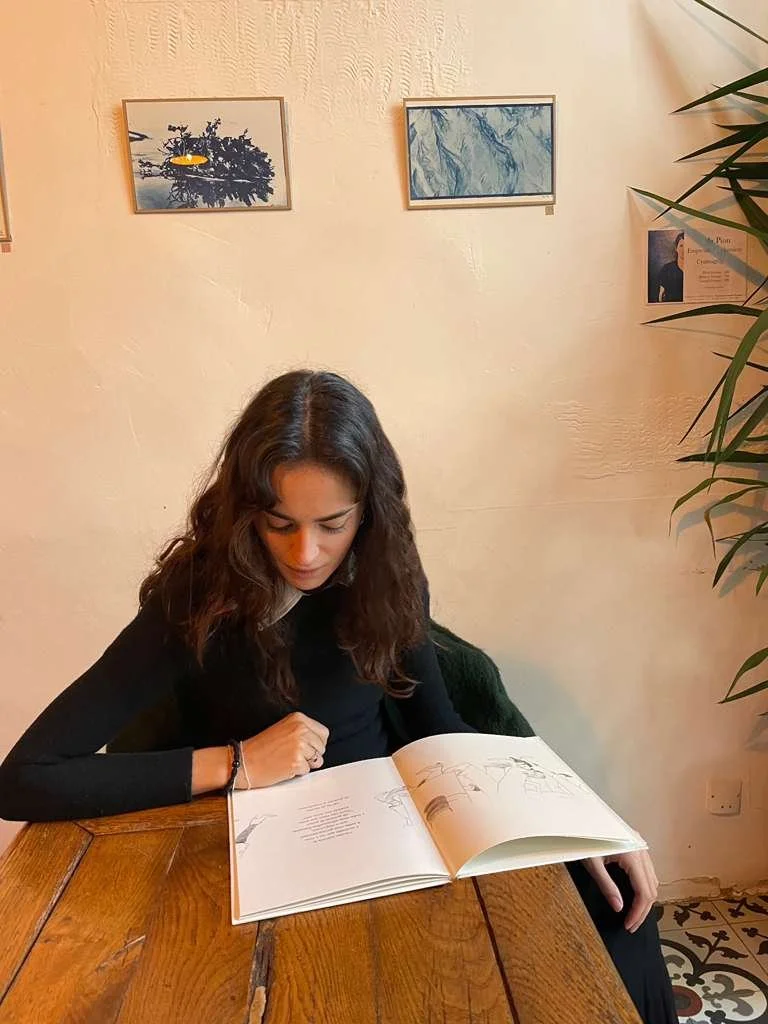
Proximity as a Line of Flight: Emilia González Salgado & Gabriela Román González
Conversation with artist Emilia González Salgado and curator Gabriela Román González on the role of trust and care in creative collaboration, looking back at the making of What do we risk by coming closer?, the exhibition that opened Lines of Flight programme at Brixton House.
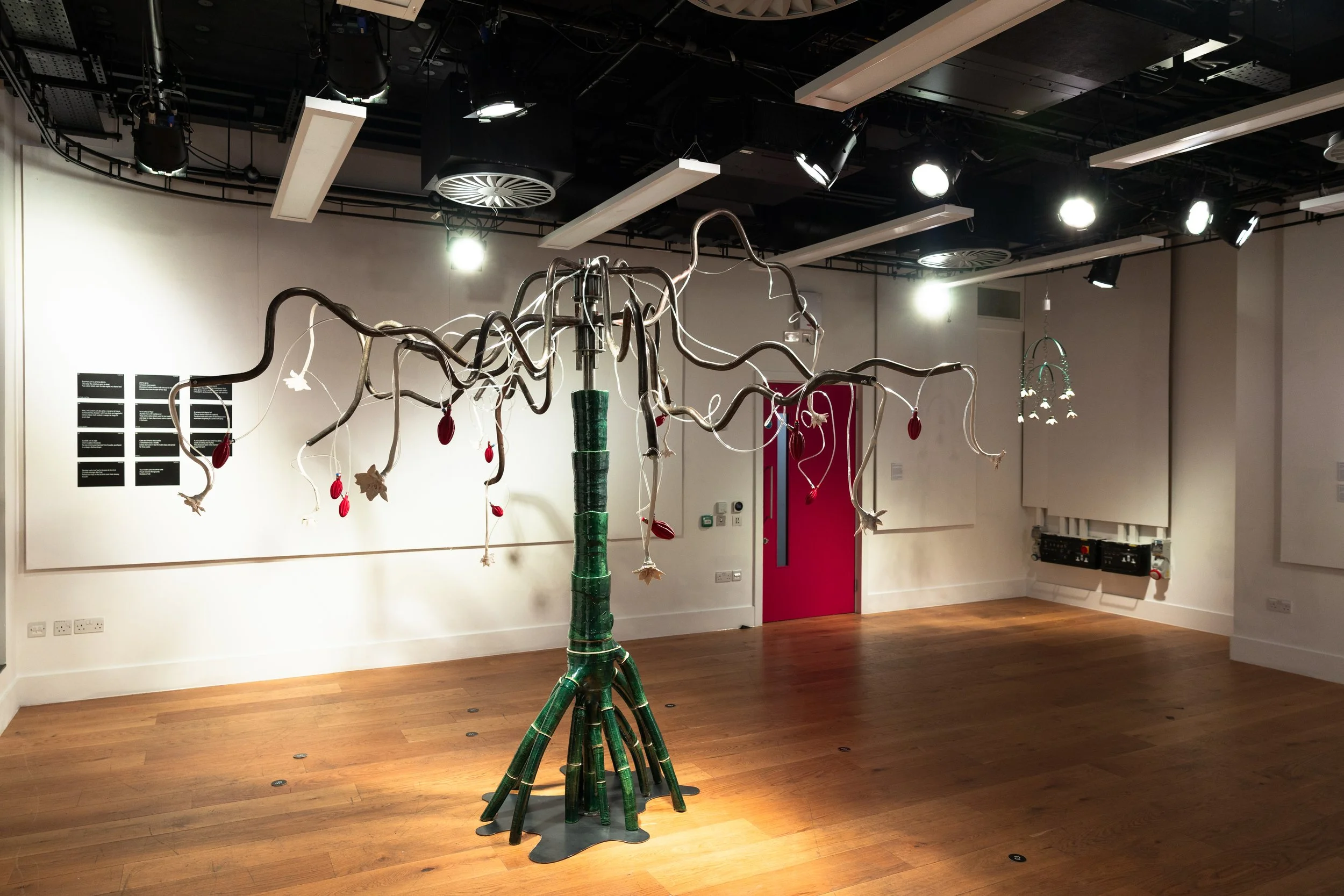
Palma que Camina; clay, steel, porcelain, rubber, vapour-distilled essences, 2024
I’d like to follow some of the themes from the exhibition, particularly its use of proximity as both method and material. Emilia, I found your practice unavoidably intimate and closely connected to individual memory. I was struck by a line in the introductory exhibition text: “attention itself can be a form of contact,” which made me wonder about the relation between attention and care. Do you see your work as an act of care towards personal or shared memory? And how might this attention extend to the diasporic experience?
Considering attention in regards to proximity, I did a lot of research about leaning and reaching. My process usually emphasizes scents as a material exploration, but here it was also a choreographic study. Not in my body in relation to the works, but in how the works required other bodies to activate and occupy them.
I started reading about leaning and reaching as gestures of care that are usually performed by female bodies. In art history, most depictions of female forms are leaning, because in leaning, you are inherently putting yourself out of balance, therefore at risk. They are vulnerable positions that are required as gestures of care, and this was the starting point in my study on how the body touched or reached for the work.
For every piece I make, I start by sketching bodies and how they might reach up, lean, crouch, or have to get really close to something to smell it. In all of those positions, you are inherently destabilising yourself physically in space - but you are also being perceived when you take on these positions. It generates an awareness of self through the destabilisation, as well as through the fact it asks something of you beyond looking, giving a role for your body to take and be witnessed.
Another form of attention for me is translation, both in language and in how scent can transmute a memory. I make work based on my home in Ecuador, and I show it here in the UK, and this overlaps with Gabriela. We had a lot of conversations about familiarity and closeness when you're from similar places, but not exactly the same, with different histories, yet so much overlap. It can be easy to find comfort and familiarity, and to become more vulnerable in those interactions because of that closeness. There are still edges, and those edges may touch, but at the end of the day you are left staring into each other’s distance.
Being asked to touch the work in the show, you may have felt like you shouldn’t because of the fragility of the material. It forced you to negotiate your form in that space, and to become aware of the touch through inhalation, and through breathing in my own memories that might permeate into your own. This is why, in Palma que Camina, I like to have the scents separate. You need to walk to the wall to know what the scents are. The first touch is just for you and you feel whatever that scent stirs within yourself, and then you get to figure out what it is for me. As the artist and the viewer, both our memories can resist, meet, overlap, and bleed into each other. Attention forces you to look at things in a different way, which is where it becomes method.
Gabriela, in terms of your curatorial work for this exhibition, did you feel it was an act of care or attention? And if so, how?
For me, care and attention are closely related.
I first visited Emilia's studio at the beginning of last year, and what stayed with me was the atmosphere her work creates and the particular way it invites people to engage with it. I totally loved her work, and I was interested in understanding what her practice was already doing and how to create the conditions for others to experience that more fully. Then, I recognised a broader question about what it means to come closer to something or someone we don’t fully know, and from this process emerged a pathway to explore what proximity demands of us.
Closeness is often imagined as something tender or intuitive, but it is also a complex process, because truly getting to know someone, or trying to understand something unfamiliar, requires vulnerability. It means entering into small or larger negotiations with yourself, with another person, with another culture, etc. I’m interested in the kinds of questions those negotiations might open up in relation to life, intimacy and our fears.
Something I discussed with Emilia was that, when we encounter something unfamiliar, we often try to make it fit within our existing frameworks as quickly as possible. We want to name it, classify it, and therefore regain control over it. But I think real proximity asks us to remain with the unknown a little longer and allow ourselves to be affected before rushing to interpretation. So perhaps that is where the care and attention was in the curatorial proposal, in the opportunity to work with Emilia as a way to go deeper into these ideas, and to open a discussion about why it might be important not to move away from uncomfortable feelings too quickly.
A core theme running through Lines of Flight is existing within a space of what is not known, and staying with discomfort without rushing to resolve it. What do we risk by coming closer? explored this through proximity, and what it might ask of us to move closer to something we don’t fully know.
Emilia, how did you understand proximity as a line of flight?
Thinking through the idea of occupying spaces that are not known and settling into the discomfort that might carry, distance and diaspora became a big part of the conversation. For Gabriela and me, considering the proximity of our home countries, working together inherently carried mutual familiarity. With that proximity came certain gestures of care from an awareness of each other's distances, and the fact that we were making choices while occupying faraway spaces. Yet somehow it felt as if there were many lines going through us that were the points in common, because we were so keenly aware of what occupying those distances implied.
A lot of my conflict with my own work is thinking: How do my affects and understandings of identity and place make sense if I'm making work so far away from the reasons I feel those things or identify in those ways? I’m still providing evidence at these points of tension, like having had the Ecuadorian Highland in the middle of Brixton, or the palma tree that grows where my parents have a house in the forest. It ends up being a way of informing and also dislocating the forms as a way of bridging distance and making the distant present.
The majority of the works were essentially love letters to either people or places. They ended up being so because I was not only making work about individuals, but also asking them to be vulnerable enough to share traces of themselves with me, like the the scent left after sleeping, the sweat from dancing, or something that emerged through conversation. The orchid piece, for example, was not just Felipe’s smell, but through talking to him I made the piece, and then we just sat down and made food together while we distilled the smell.
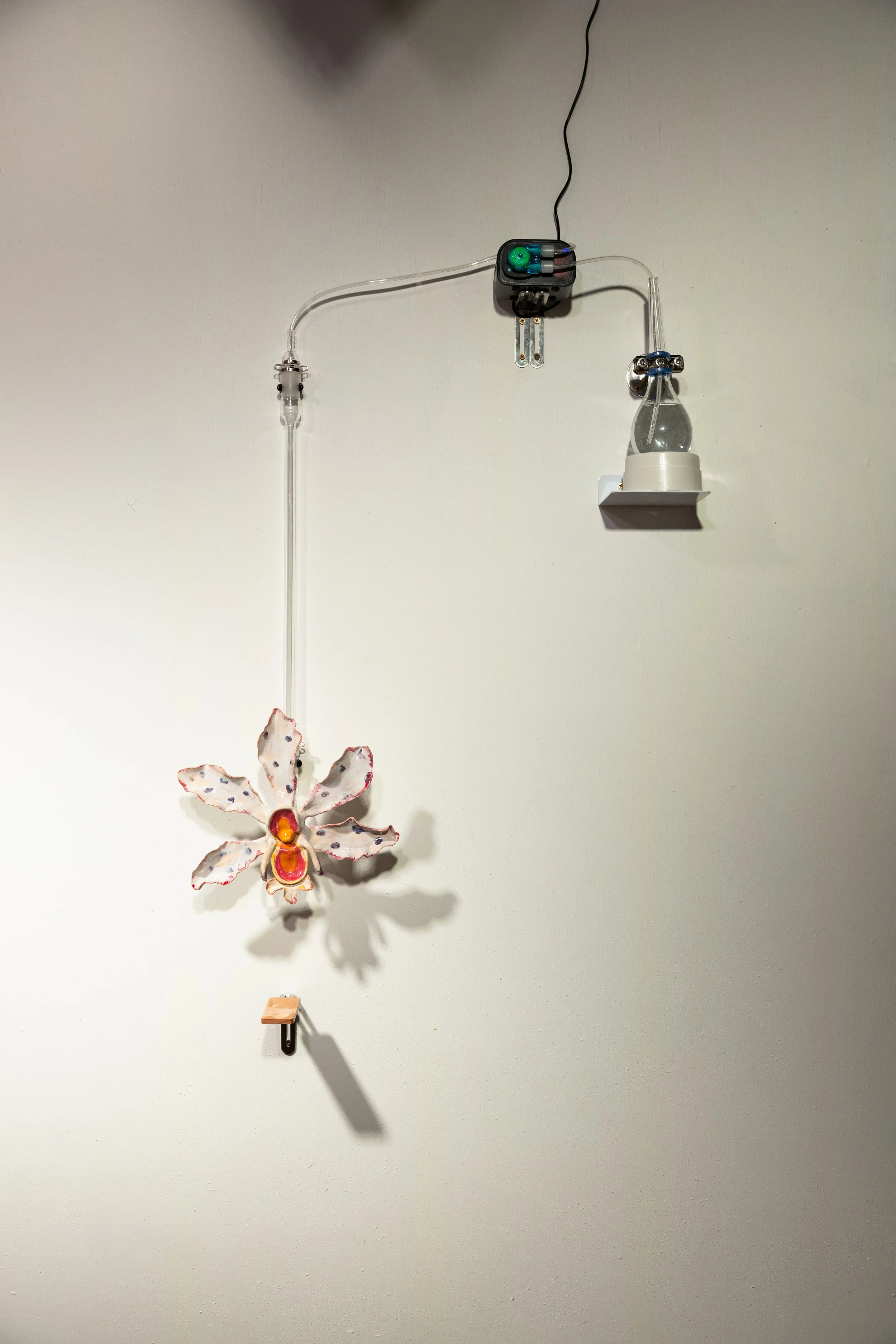
Acolitar: seguir o ayudar, clay, borosilicate glass, peristaltic pump, wood, hardware, scent distilled with Felipe Pineda from plants sent from her mother’s garden, 2025
I was really happy to be doing this with Gabriela, as she is really good at doing that for people. We didn't really know each other and she invited me to her birthday and cooked Cuban food for, like 25 or like 30 of us, and then we danced in her yard. Moments like that create proximity and care from very small gestures of exchange. I think that was a big part of my collaboration with Gabriela, in our conversations and how they took place, but also in my intentions with the work and my relationship to my home and the people I care about.
Gabriela, I wanted to ask about your intention and approach as a curator. Were there guidelines that you put in place for yourself when given the chance to curate Emilia's work?
I don’t know if I would describe them as guidelines, but there is definitely a way of working that is important to me, and that also shapes Lines of Flight as a programme.
At the moment, with the artists I work with, I don’t usually go straight into the idea of an exhibition. There are always certain gut feelings and intuitions, but I first try to get closer to the person, to understand more about their life stories and creative practice, and hopefully to begin building a relationship of trust and dialogue. Of course, that is not always possible in the same way with every project, but I think some of the strongest exhibitions I have curated have come from that professional and emotional connection between my practice and the artist’s work. With Emilia, that connection felt very natural. Her work speaks to many things that are important to me in life and in art.
At the same time, curating sensorial and interactive work is something I am very interested in. Lately, this has been linked to a difficult but important exercise for me, which is trying to avoid over-intellectualising the experience. I’m interested in offering guiding frameworks, information and questions that can open up the encounter. I don’t want to tell people what they need to feel or understand before they experience the art.
In that sense, something very important in What do we risk by coming closer? was not to prescribe vulnerability, or to tell people what they were supposed to feel or take from the work. For me, and I think Emilia also spoke about this, it was about creating a certain atmosphere as people walked in. I see the gallery as a landscape where encounters can happen. From there, you started thinking about every detail: what audiences would find when they arrived, how they would move, what they awould be invited to notice, and what kind of attention the space would allow.
This exhibition gave authority to the viewer. I think that's something that enables your work, Emilia, but also your work, Gabriela, as the curatorial approach shapes how the exhibition is experienced. What risks did the project ask of you both personally, and what risks did you hope the audience would be willing to take when they entered the space?
Emilia: This was a part of a conversation Gabriela and I had beforehand, because we knew different audiences interact differently with my work, especially with scent and emotionally sensitive work. I’ve noticed British audiences are very self-aware. I had a tutor that described the encounter with my work as flirting - the risks were similar to those prior to a sexual encounter; you approach, hesitate, then lean in. I have a piece that makes you smell your hand, and I have noticed people will touch the work, and then look around to see if they're being watched as they smell it. There is an inherent risk in inhaling that is protective of the body, but then there is a risk in being watched, being vulnerable.
With scent, this is a very straightforward risk and we are very prone to judging bad smells. I do try to walk a line between pleasure and disgust with the scents in my work. I'm not trying to make nice scents, because a lot of the scents that usually prompt memories walk that line as well. For this exhibition I wanted to evoke the body parts that you were smelling, and to be forced into that discomfort always feels like a risk.
Remembering can also be a risk and a lot of people do have very personal reactions to the work. I’m aware that there is an emotional fragility involved. At the opening, a couple of people approached me and said, ‘This makes me think of someone specific,’ or of a very specific moment in their past, which is one of the beautiful things about scent — it activates something of its own and doesn’t narrate my memory exactly, I'm simply offering my memory as a point of access.
For me, the risk was exposing my emotions. Every piece was centred around something I feel, and that's risky because I’m trying to simultaneously expose my emotions without trying to say much about myself. It doesn't always feel like there's a safe distance, because when people see my work, they see into me, maybe more than I anticipate a lot of the time. It can be quite strange and uncomfortable as well, but that gives it a lot of meaning too.
There were unseen risks involved too, especially reopening the tree - because the other three pieces were scents I’d encountered recently - the tree had been in storage for a year and all the scents had been bottled up. So opening it, I smelled a lot of small moments of a very significant year in my life. This constant access to my own emotional memory is really uncomfortable, and something I force myself to reopen constantly.
Gabriela: For me, the personal risk was allowing the process to remain open for longer than felt comfortable. I often speak about trusting the process, but when you actually have to do it, it is not as romantic as it sounds. It can feel quite disorienting because you have to find the right balance between letting go of control in many moments and still holding the process with enough care and clarity. So part of the challenge is always to honour the rhythm of the creative process and resist the temptation to organise everything too quickly. In that sense, Emilia and I also had to practise the question the exhibition was asking.
Even within the pressure of making the exhibition happen, it became important to protect a space for exploration, especially because we were not only working with Emilia’s previous work, but were also giving her space to create two new pieces for the exhibition. We had many conversations about different works that were not shown in the end, but that back and forth was important because it allowed us to understand the space, test ideas, and let something more organic emerge. Our trust in each other grew throughout the process, and I think that is partly why the result felt so meaningful to me.
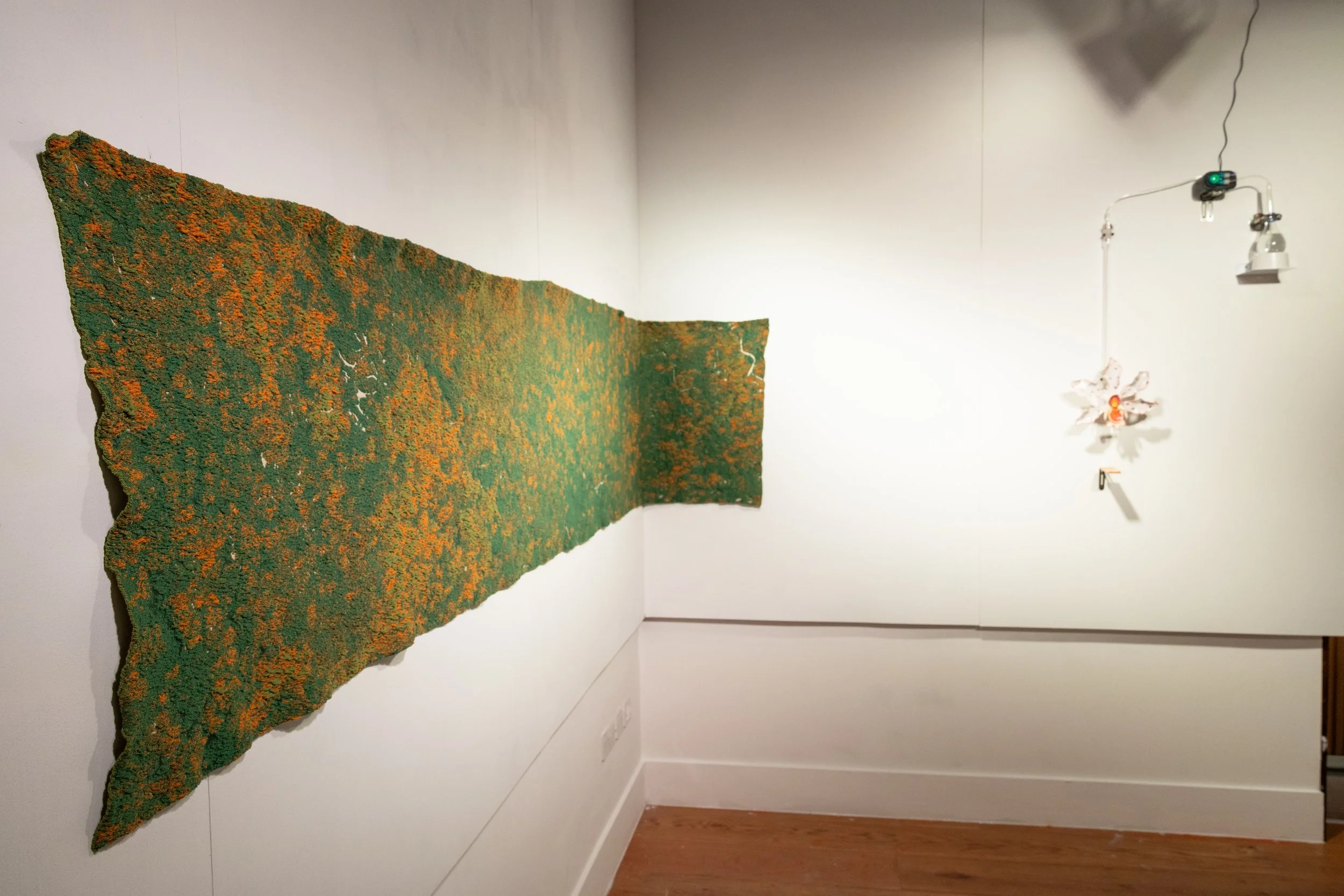
Suelo de Paramo (Ground Study No. 9), merino wool, mercerised cotton, elastic, vapour-distilled scent of Antisana ground, On-going
The risk I hoped audiences would take was to allow themselves to experience the work beyond the visual. Something that has always interested me when working with sensorial pieces is the possibility of moving the eyes away from being the only protagonist. Experience does not happen only through looking. Memory can be built, or suddenly reactivated, through music, smell and texture, and Emilia’s work is so good at doing that. With Suelo de Páramo, for example, you could smell the earth, and that immediately made me think of memories I have from Cuba, of when it rains and you can smell the wet soil. Those things are very simple, but they can carry a lot. They have the potential to keep opening more and more layers of association and meaning.
Emilia: There is also, always, the risk of someone else speaking for your work. A lot of the time it can lead to things feeling like they become no one's work. With Gabriela that trust never felt like a question and looking back on it, I feel very honestly represented and honestly listened to.
Gabriela: I'm really glad to hear that.
I could feel this relationship of trust and care between the two of you as a viewer. I think it opens up possibilities for other artists and curators to think about the role trust and care might play in their own ways of working together.