The Chakana as a Line of Flight: Victoria Vargas Downing
Conversation with Chilean researcher Victoria Vargas Downing
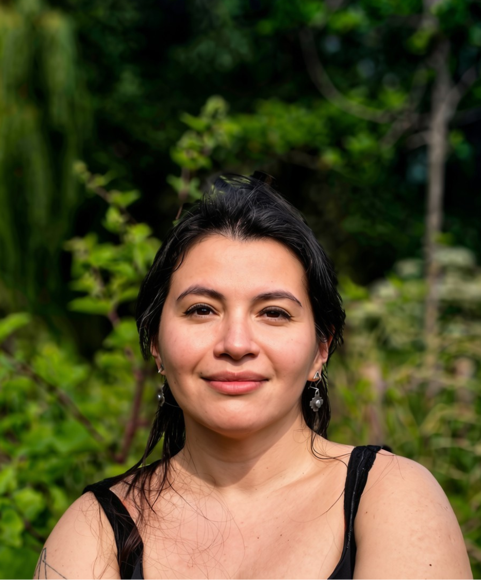
Downings’ practice unfolds from a position of geographic, cultural, and epistemic in-betweenness. Raised in the Atacama Desert and now based in the UK, Victoria reflects on the tensions of inhabiting multiple worlds at once, and how that condition shapes her approach to knowledge-making, responsibility, and care.
Our dialogue traces how assumptions around migration, privilege, and academic legitimacy can be unsettled through sustained attention to ambivalence rather than resolution. At the centre of Victoria’s methodology is the chakana, an Andean cosmological symbol she mobilises as a research structure that resists linear, hierarchical models of Western thought. Through it, she proposes a way of thinking that can hold contradiction, interdependence, and spiritual, material, and intellectual knowledge all at once.
Migration and research
How do you locate yourself within your research practices? Geographically, culturally, and intellectually?
I'm a Latin American researcher, originally from the Atacama desert in Chile. I've been in the UK for 10 years more or less. My work is located in this migrant position, and I think about both sides with a broad view, meaning my thought is shaped by these two currents. One side being Western thought (through school and academic formation), and the other being my learnings growing up in the desert that have deeply influenced my way of thinking and experience. When migrating, those two identities get conflicted. When I'm in the UK, I know that I'm not from there, but when I'm in Chile, I still feel a bit out of place. I try to deal with that inner conflict in the best way that I can, valuing both positions because both have privilege, but also they lack privilege in different places. They are dynamic depending on the place where I am standing in the literal sense.
When you're confronted with questions about your experience being a Chilean researcher working in the UK, do you feel limited in the way you want to be received?
I think questions like that have assumptions behind them. What does it mean to be a Chilean researcher in the UK? Those are not the same implications or assumptions as saying you are a European/white researcher in Chile, or a Chilean researcher that has lived in the UK and returned to Chile. So expectations may vary from the place we are asking that question. For example, when people say, "Oh, you live in the UK,” they often think I’m living a luxurious life - compared to life in Chile, my life is very privileged, but when I'm in the UK my life is pretty average. I'm dealing with the same issues all people feel in everyday life in their countries, but in the UK I am an immigrant which makes a huge difference. I find there are assumptions made when you hear someone is living in Europe, and we forget about the hostilities of migration for the majority of the world. As a researcher, I see those questions as a chance to ask what assumptions we have, and how can we start to untangle or undo those assumptions? What do people see when I am approaching as a researcher? Do they expect me to be a researcher? Do they limit the way that my work may be received and why, once they notice I am Chilean? I hope not, but do they? Then my approach is to make them see these assumptions if they have them.
That puts a lot of responsibility on you to offer explanations to many different groups of people.
Yes, but I won't do all the work - this is part of the work we have to do together. If you have these assumptions, maybe it's the moment that you need to accept and question where they come from or what other assumptions are behind them. So I think that you're right, it's a lot of responsibility, but it's a starting point. It's asking yourself what your accountability is, and I know I can be accountable when I bring these assumptions to attention. That’s why I work with decolonisation, because although it is personal, it is also collective work, but you have to do the work.
What genealogies or lineages feel most present in your research, and how might they inform the way you approach knowledge making or world building in your thinking?
In origin, the genealogy is Western oriented, but this is because in Chile, the education you receive (I received) is always from the West. Educational, cultural and economic frameworks are embedded in Western forms of thought, knowledge and disciplines. We were taught the history of Europe, we learned about the wars, we even learned about the United States, but the local Indigenous history is maybe one page in the history book. At the same time, while growing up in the desert, I also have a connection and interaction with the landscape and the ocean, which frames my way of understanding the world. That mix allows me to see both and enter into a dialogue that questions the validity of one way of knowing over another, and saying that one is not better or worse than the other, while asking how we can do better, because that is the point. At this point in history, the idea of development and progress is not necessarily something that is making the world a better place.
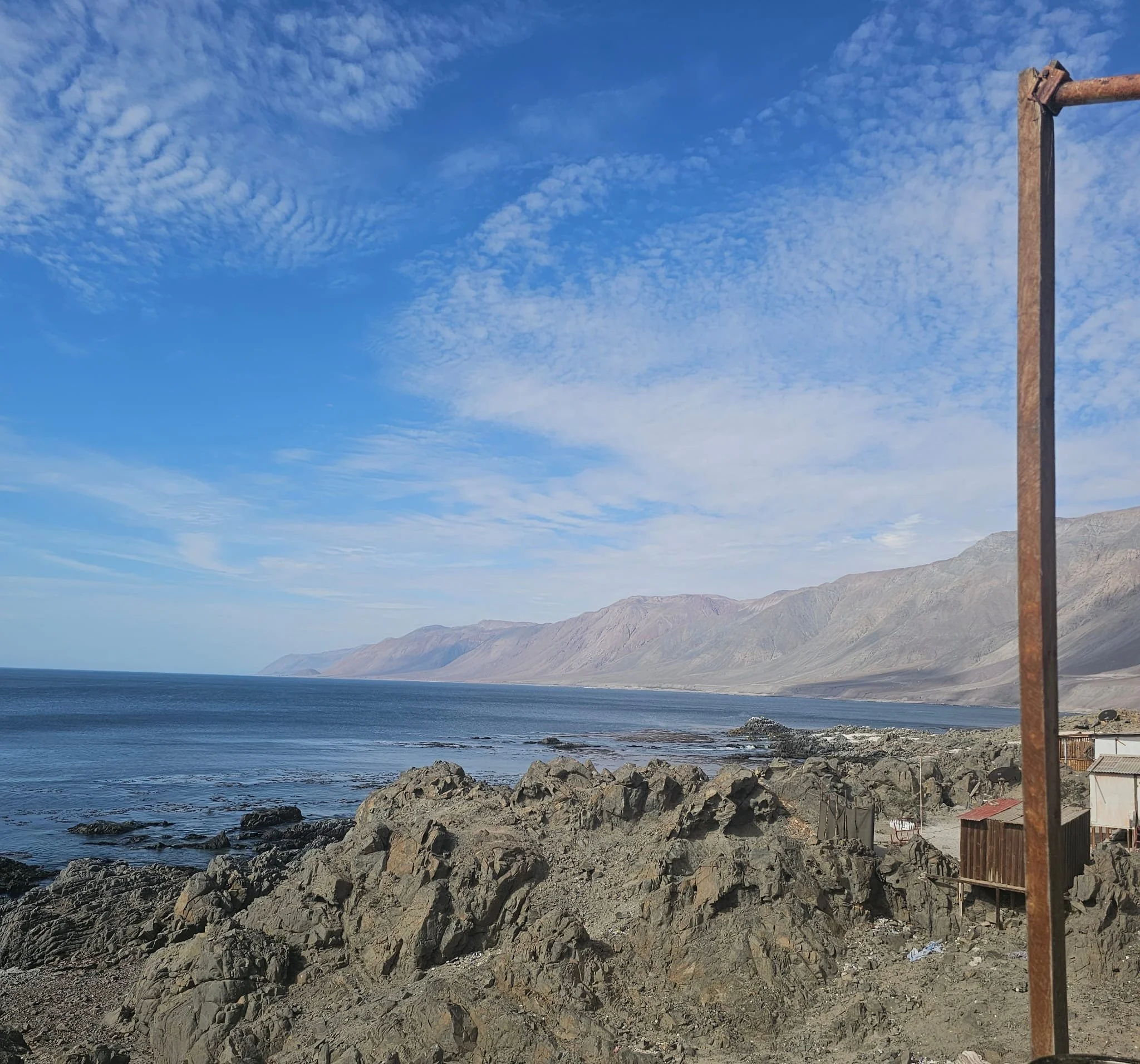
Where the Atacama Desert meets the Pacific Ocean. Image credits Victoria Vargas Downing
Chakana as a methodology
To speak more specifically about your research and practice, I'd love to hear you speak about your work with the chakana, and how it resists linear and hierarchical forms of academic writing. I wonder if this methodology emerged for you out of your own personal understanding of research and how you grew up in a landscape that is grounded in natural properties that provide knowledge?
Using the chakana as a methodology emerged from personal experience and reflection about hegemonic ways of thinking and contributing to knowledge, I had to re-shape my thinking and knowledge. In the north of Chile, you see chakanas everywhere - It's a symbol that is in the streets, in paintings, and murals. It is a Pan-American and Latin American symbol that is also the Southern Cross. It connects the spiritual with the underworld, it is a crossed path, a bridge and so on. When I moved to the UK, I started to see it in different places. I became a bit obsessed with what this meant, and why it appeared everywhere. I felt I had to pay attention and see what it had to say to me.
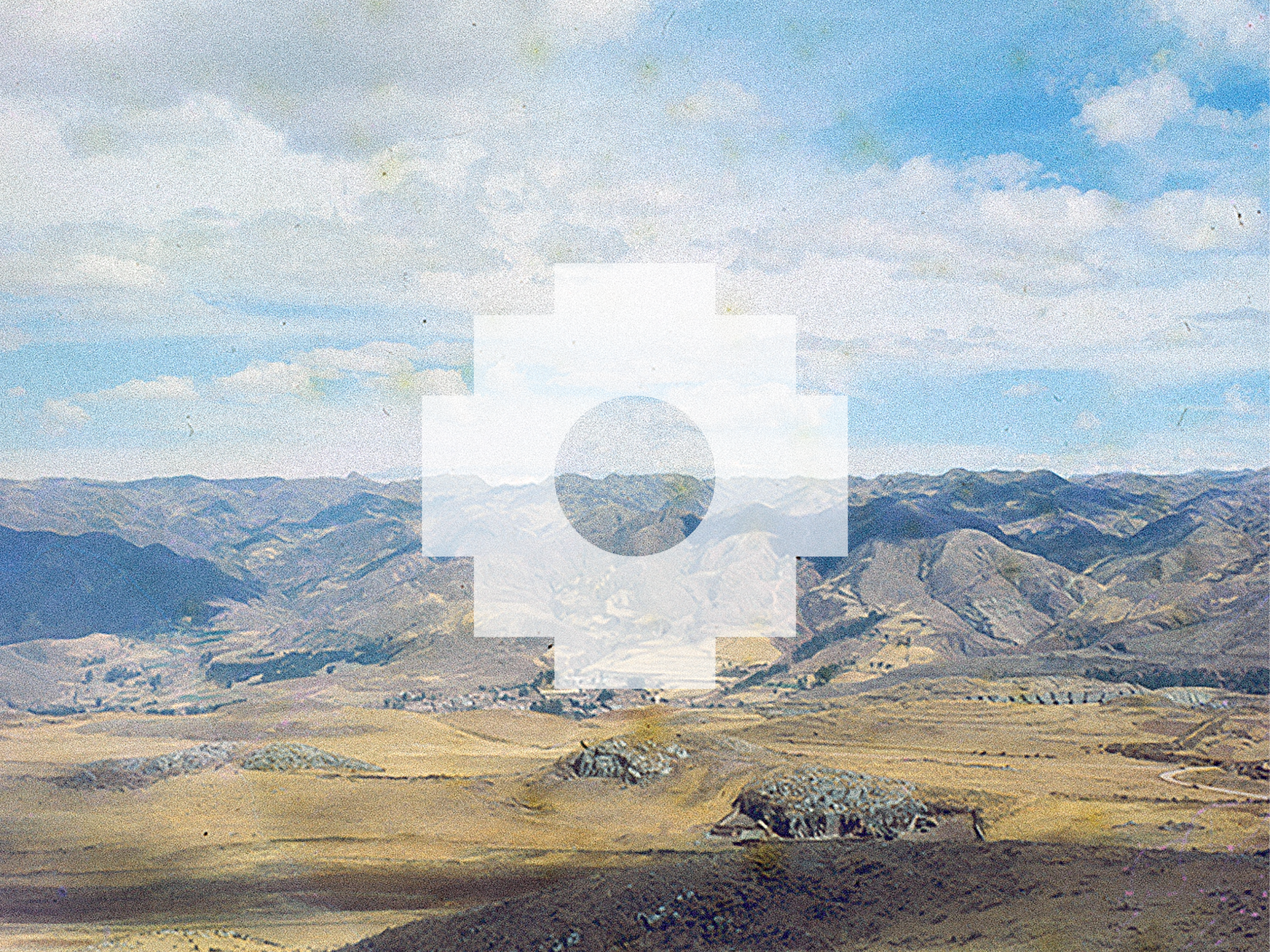
The chakana symbol over an Andean landscape, dividing the axis between sky and earth. Original production. Photograph by Sergio Larrain Garcia-Moreno. ©Chilean Museum of Pre-Columbian Art.
I began to research and started to understand how the chakana connects different worlds and different ways of thinking. It exists in ambivalence, but also creates some tension, moves, and has multiple meanings and ways of appearing in the world. Considering that it has this plural meaning depending where and how it appears, it retains a physical space and can be a pathway. All those layers sometimes overlap, and sometimes they are different. I started to ask what is occurring, and how can I understand it better? In that process of chaos and questing, I was struggling because of the contradiction in deciding to write a thesis about colonisation in a colonial institution (the university). This forced me to deal with the strongest points of tension I could see.
In that process, I knew I didn't want to write a thesis that was completely linear. Linearity is one of the keys within Western thought that pushes you to move forward to the future without looking at the past, because it's behind you. For my thinking, linearity would not allow me to move through different topics while keeping unity to converse between different worlds, to the contradictions of worlds when writing about colonisation within a colonial institution, and writing about heritage when it is also one of the bases within Western thought and colonial settings. In that urge to find a shape is where the chakana appears again and again. I then came to three concepts of my research that could connect topics and elements I thought were key for understanding the depth of my contradictions.
First, I wanted to address the internal tension within the different worlds the chakana proposes, remembering tension is a force that elongates shapes and can change structures, but also contains elements of communication in its administration of forces. Second, was the ambivalent space, and how it's often not allowed in Western thought, in the sense you have to pick one thing - whether you write in Spanish or in English, whether you focus on the future or the past - reproducing binary thinking by picking one thing instead of thinking with those contradictions. In those moments, another of my contradictions was and is being Latin American, but studying Latin America in the UK. It's a contradiction that developed my thought process and guided me in staying with that ambivalence without breaking tension or cutting the link that is unifying that ambivalence. The third point was the precarity within Western thought, and the idea that things are either forever or you need to keep moving toward the future at all times, which does not allow precarity or vulnerability. This way of thinking, constantly moving forward is very individualistic, does not allow us to stop or rest, while precarity reminds us that we are interdependent, reminds us how to connect with others, and more importantly how we learn with others, which is less recognised. Once I identified that, I thought how can I make these three concepts work within a chakana structure? That is how I got to the idea of keeping those connections, and thinking about the chakana as a way of retaining those dialogues without breaking or separating the links. I used the chakana as an ontology and methodology, keeping those dialogues and connections and seeing how the chakana offers ways of thinking that are not Western oriented, creating knowledge by connecting instead of devaluating other ways of thinking.
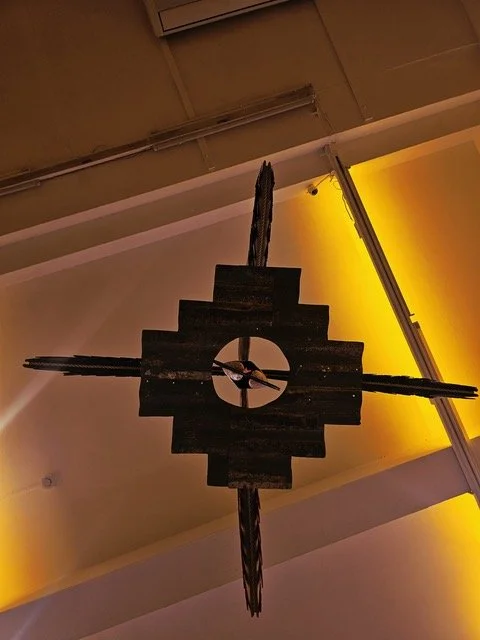
Natalia Montoya, Chakana, Radiación Ocre, 2026
I think that's extremely useful for so many different forms of practice. It's as if this ambiguity is a realm of its own existence.
Yes, and it doesn't mean neutrality, I think that it is important to say. It means mainly to continue understanding where you are standing right now, and being very clear about the reasons why that position is present. That doesn't mean that you can't change positions, because your circumstances are going to change. So this framework is dynamic and moves depending on what you're doing, how you're thinking, or what you're feeling and the interactions of everyday life. It's about considering how the body of the chakana is also somehow present with your body.
For example, Western thought is very rational. The head is the top of the body, and you have this division of the mental versus the physical. But the chakana is mental, physical, and spiritual at the same time. The idea is how you can incorporate your whole self with all those contradictions, divisions, and feelings because knowledge is not created from a detached subject or detached object. I believe that knowledge is created in the exchange of touch - something that touches and creates knowledge in that exchange, it is more embodied than we realise. It's recognising there are other ways of thinking that rely more on interaction and interdependence than just from detached subjects of knowledge.
I think that lies within more than human relationships, which I think is something that you've thought about before as well.
Yes, because again, in Western institutions we think about objects as un-alive, and plants as alive but they don't have agency in the world, but I do think that we communicate with plants. There are recent studies that claim plants communicate through their roots when they need water, screaming at a low pitch. Humans cannot hear it, but our bodies receive all the vibrations of sound. We are not trying to understand other ways of communicating that are not within the rationale of Western thoughts. Other societies and Indigenous communities, particularly, have been trying to understand when the wind says something, or when the ocean is brave, mountains also have personalities and moods, ‘está feliz’ (it is happy), ‘está triste’ (it is sad) are expressions used in the Andes by people living nearby mountains. These are different ways of understanding that we are not trained to capture, how other beings, human and non-human are communicating.
Therefore rethinking what modes of knowledge we give authority to. How do you position research that listens to mountains, to threads, to plants, or to the ocean?
I think it is about being aware of the interdependency that we have with mountains and rivers. Because we are composed of these elements, we are part of the mountain, we receive the nutrients from the soil, or from the earth, with the plants and vegetables that we can consume. We receive the memory of the water we drink. Now, we are receiving more information about the industry when we drink water from plastic bottles. It carries a different memory; a memory of pollution in industrialization that brings the violence on which it has been extracted, and the same with land.
I think that when doing research that is aware of how we can listen to other beings and other persons, you need to be very aware of what is going on with your body in connection to those beings. In Moira Millán’s book, Terricide: Ancestral Wisdom for an Alternative World, there is a section where she's talking with someone in the Patagonian region of Argentina, explaining how the water we drink doesn't have memory anymore because it comes in plastic bottles, we no longer drink from the mountain or the river.
In my experience abroad and growing up in the Atacama, I am slowly healing my relationship with water. As a child I could never drink water from the tap because it had arsenic and other chemicals from the mining industry. In that sense, my own relationship with drinking water has been complicated because all I heard was, ‘don't drink that water from the tap, it can kill you, drink water from a plastic bottle instead. That affected my relationship with water and drinking water. I have reconciled with water through the ocean, and by going to rivers, walking-by bodies of water and understanding its cycle. I still drink water from bottles, but at least now I drink water. Then that knowledge and information from that bottle is coming to me, and I need to decide if I want to receive it or how to approach it or not.
The role of the institution
How do you navigate the tension between decolonial methodologies such as this and the demands that you need to meet at an academic institution?
Well, I don't know if I'm meeting them. I'm not a person that remains quiet when something unfair is happening. Particularly within academia, you hear a lot about decolonial efforts. There are plenty of projects that have the word ‘decolonising’ in the title, but the way the word is being used feels superficial, and doesn’t address the knowledge inequality or power imbalances. The privilege of the self in Western academia is a topic I am calling attention to in an article I’m writing now called Not Enough. It is rooted in my own experience and feelings of not being enough for Western academia, or thinking I am not enough because I am not within the hegemonic paradigm. My English is never going to be good enough for academic standards, but I don't have any intention to be good enough for them. I did enough by learning the language, speaking now in two extra languages. Academia asks (you) to do more and more, when they are not doing enough to accomplish their decolonial aims.
In terms of achievements, I think that it is a spiral of criticism. It's not about asking me or other global majority people to do more, we do all we can and more. Instead it's about stop asking for more, and ask how Western academia can do enough, because at this moment they are not doing enough in terms of addressing the knowledge inequality, epistemic justice or environmental justice. They are not doing enough balancing their privilege, or even acknowledging their privilege. Academia has a lot to do in terms of decolonisation and really being decolonial, without kidnapping the word ‘decolonisation’ for their own benefit. They need to be more critical regarding what else they can do to allow decolonisation to happen. It's related in terms of visas, contracts, etc.
I know these barriers are institutional, it says more about the institutions than the individual people. In that same pattern of trying to do as much as I can, I also have to say that I've been very lucky in having good mentors and colleagues that I trust and helped me to sustain within the precarity of academia. There are very strong links of solidarity within academia that I can rely on when academia makes me feel like I am not enough.
I think that's a very justified critique. I can imagine how it might feel for you living in the UK as a researcher and someone that offers first perspective knowledge.
Decolonisation is individual, but also collective. It's a collective process where I can do my best to unlearn myself, but if you don't want to I can't force you. Imposing my thoughts onto others would be reproducing the same ways of thinking we are saying no to. We need to find different ways of working, thinking, and collaborating.
I think precarity/care are the right ways to navigate it, but could it also be about timing and whether institutions are ready or interested in receiving?
I don't think institutions are ready or want to receive it, because it often goes against the same institution. I don't think we can change the institution in a way that is radical, but there is strength from the solidarity work that we do on an everyday basis. It's a way of reflecting within the work, in a consistent way with care and being among peers.
The methodology we're using for the interview series draws on the idea of lines of flight: movements that depart from established structures or ways of thinking and open up other possibilities. It's not an exit, but more so a transformation. How do you see artistic or academic practices you have thought about previously or now that are creating these openings or transformations?
Yes, I can think of two examples. As a first example I think of the work of Patricia Dominguez, which deals with technology, and how the corporate world has shaped/been shaped by spiritual thinking. To me, her practice is a line of flight because she is making those patterns visible and providing a fierce strategy of how we can exit and live in a more harmonious way, without it being all-consuming.
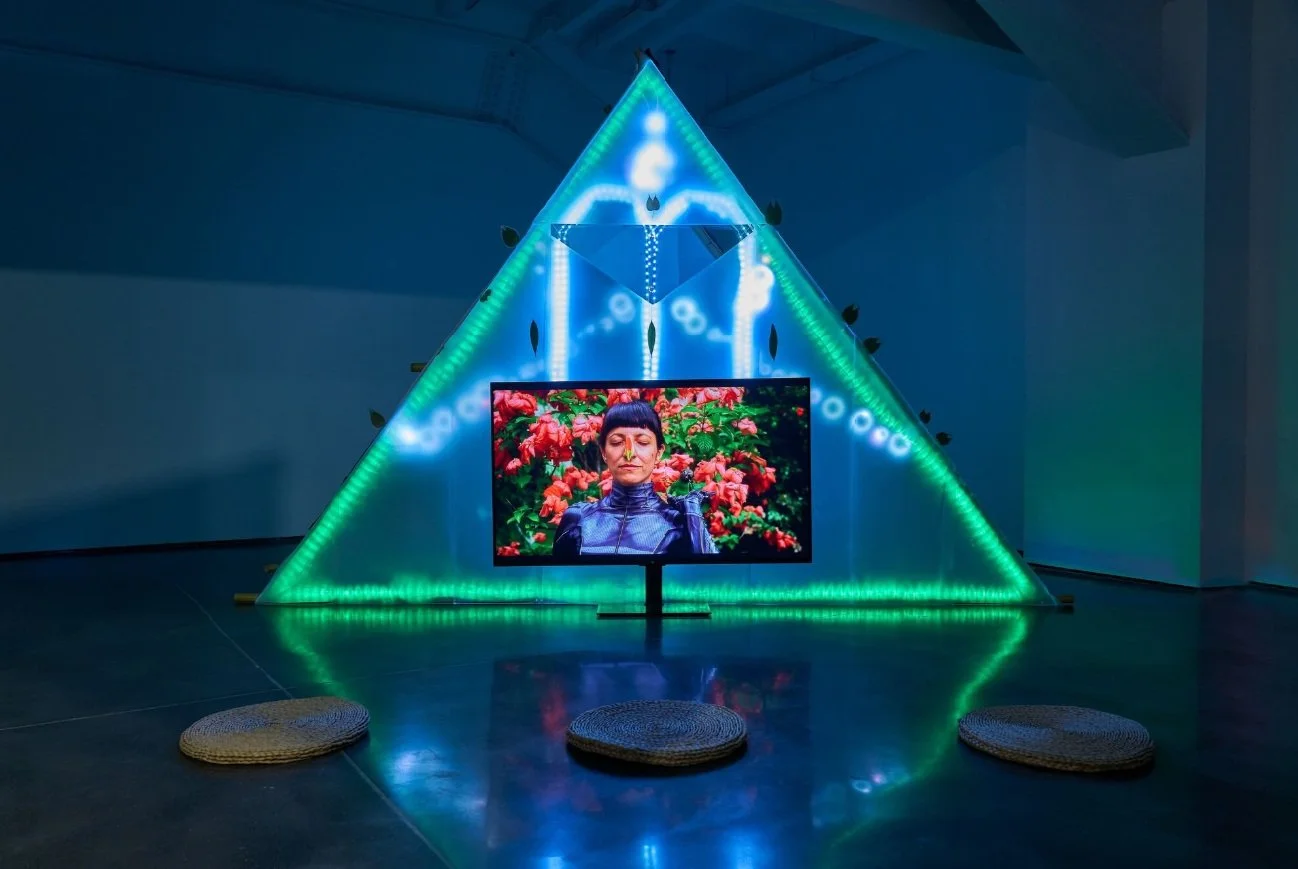
Patricia Dominguez, Matrix Vegetal, 2022
I'm also thinking of Natalia Montoya’s work, who worked for a few years in the Tarapacé area in Chile and also works with textile practices. In this case, her work puts energy and time into that ancient practice, in the repetitive gesture of weaving or even meditative action of creating adornments, she creates a connection with forms of knowledge that give relevance to the matter beyond the neoliberal value of that material reality. In a world that is very materialistic, where materiality is not linked to any kind of spirituality, practices that attempt to reconnect the spirituality and ancient knowledges propose lines of a flight. I think the process has to first acknowledge what is going on, and then address it in a way that is and can resonate with more people. Not long ago, I read we need to see the wound, so then we can start to help it to heal. When we find those contradictions and those tensions, instead of cutting the tension, we can sustain it and understand the information that is transferred and shared in that tension, then we can receive it (if we want), change things and heal (again if we want).
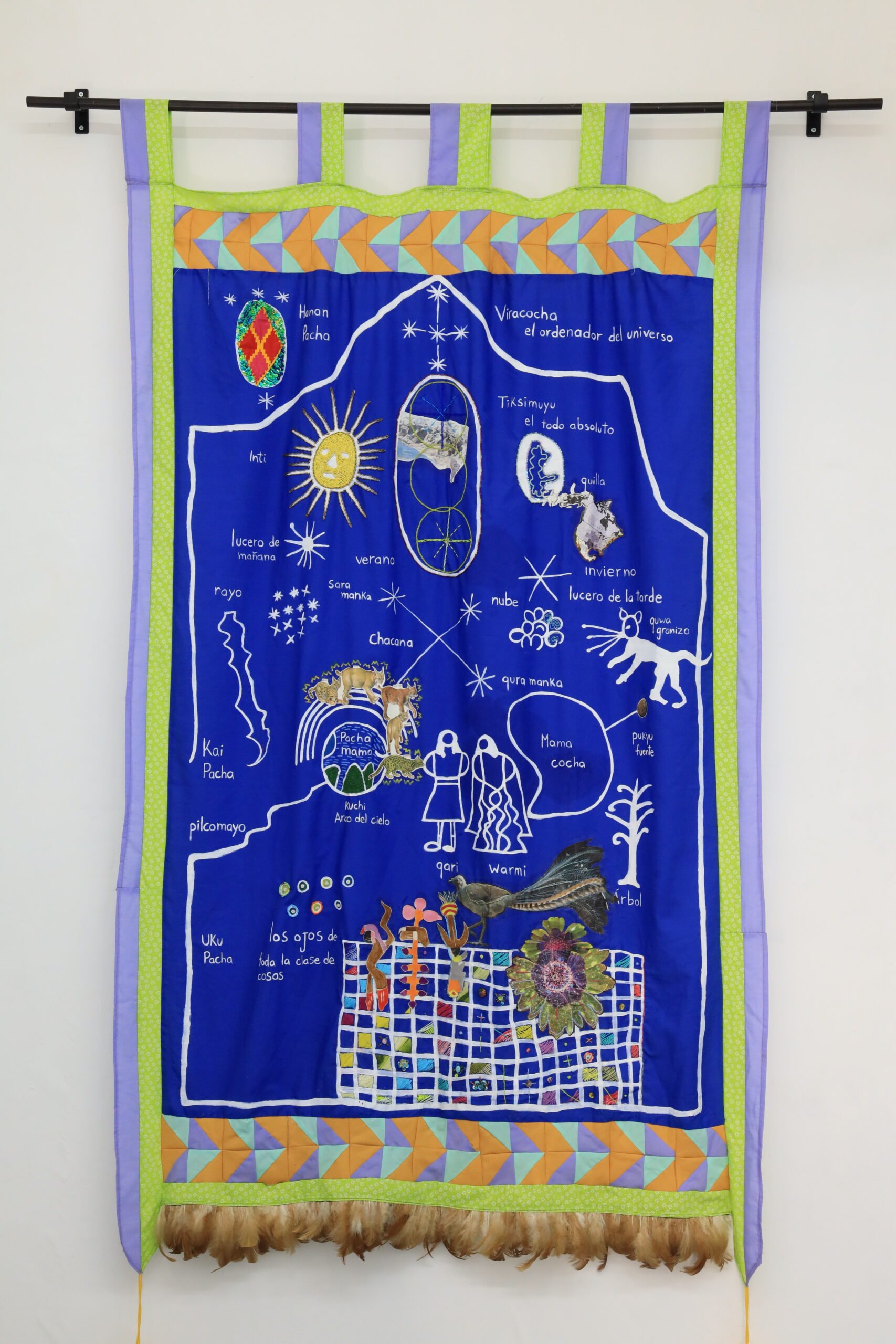
Natalia Montoya, Manto Cosmogonico, 2022
What kind of futures do you hope your work might make possible for researchers like yourself or the future of Western institutions?
It might sound contradictory, but I don't think my work is for the future of futures, what I mean is that it is not meant for the future. My intent is to work for a better present, I don't want to impose a vision that does not resonate with others presents, or take the agency of someone else to do something better. I prefer my work to be able to make changes and resonances in the presence, so we can have better futures orientated to the needs of those futures, because what I/we need now, may not be what I/we are going to need in the future. If I'm imposing my assumed future on that future, I'm taking away their agency to decide what is best for us/them. In this sense, I think that is essential; stop working for the future and start working for a better present. Western thought is overly-concerned with the future; what are we going to do in the future? How can we manage the risk of the future? We are assuming the future is going to be risky and dangerous. Instead of working in the present, to make it less risky and dangerous. In addition, instead of acting and enacting our agency in the present, we reproduce decisions imposed from the past, and project them to the future, limiting our chance of making and producing significant changes, pushing that agency forward, rather than us doing something today.
My work tries to avoid reproducing the same logics, instructions, impositions, and dispossessions. Instead, I’m trying to stop reproducing those paradigms, because in the end we are arriving at the same point, making the future potentially worse than the present. This is linked to the Indigenous thinking that influenced my work, this idea that the past is in front of you, and you can interact with it, and the future is behind you. The idea of only moving towards the future keeps the past behind us, and that doesn't imply accountability or repairing.
My work seeks to address the healing of colonial wounds. I think that it is entangled with art in the sense of how art can transform that pain, so we don't pass it on. And yes, some art and artists think about the future, but most of them try to address what is happening in the present, transforming it into something meaningful or dealing with those tensions, ambivalences and precarities that we all carry in our bodies.